


Research
Disentangling Age, Time, and Cohort Effects in Income Inequality: A Proxy Machine Learning Approach
David Bruns-Smith, Emi Nakamura, Jón Steinsson
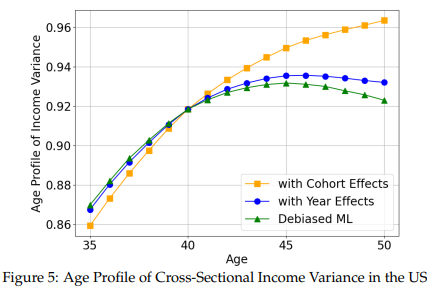
Earlier research has concluded that the cross-sectional variance of income rises steeply with age. The methods used to reach this conclusion are sensitive to the age-time-cohort identification problem. We propose a new proxy-based (debiased) machine learning approach to solve this problem. We estimate substantially less steep age profiles for the cross-sectional variance of income.
Beyond the Taylor Rule
Emi Nakamura, Venance Riblier, Jón Steinsson
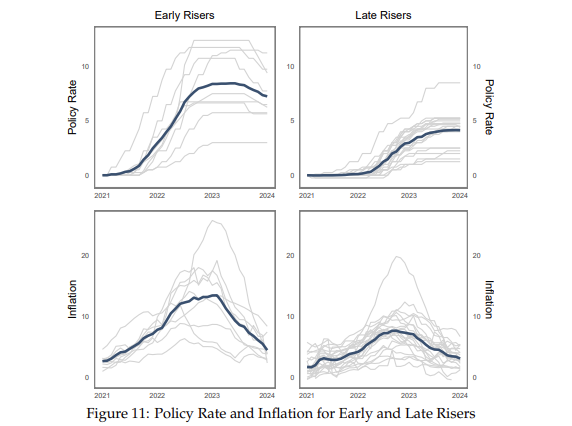
The Taylor rule fit reasonably well between 1987 and 2008, but hasn’t fit well since. Countries with relatively poor credibility of monetary policy raised rates more after Covid but experienced more inflation. Countries with more credibility were able to look through the post-Covid inflation to a greater extent. It is optimal for central banks with strong credibility to partly look through supply shocks. Concerns about indeterminacy are overblown.

Macroeconomic Effects of UI Extensions at Short and Long Durations
Miguel Acosta, Andreas Mueller, Emi Nakamura, and Jón Steinsson
The effect of UI extensions on unemployment are small when pre-extension durations are already long. These effects are quite a bit larger when pre-extension durations are smaller.

The Macroeconomic Consequences of Exchange Rate Depreciations
Masao Fukui, Emi Nakamura, and Jón Steinsson
Quarterly Journal of Economics, 140(4), 3015-3065, November 2025.
Regime-induced exchange rate depreciations are strongly expansionary. Net exports fall (ruling out an export led boom) and nominal interest rates rise (ruling out a monetary expansion). To explain these findings, we build a financially driven exchange rate model (FDX model) with a strong foreign credit channel. Our model is also consistent with exchange rate disconnect and the Mussa facts.

A Plucking Model of Business Cycles
Stéphane Dupraz, Emi Nakamura, and Jón Steinsson
Journal of Monetary Economics, 152, 103766, June 2025
US unemployment strongly displays the asymmetry that increases in unemployment are followed by decreases of similar amplitude, while the amplitude of the increase is not related to the amplitude of the previous decrease. This fact favors the plucking view that recessions are shortfalls below a maximum level rather than fluctuations around a natural rate:

When Did Growth Begin? New Estimates of Productivity Growth in England from 1250 to 1870
Paul Bouscasse, Emi Nakamura, and Jón Steinsson
Quarterly Journal of Economics, 140(2), 835-888, May 2025
Productivity growth began in England in 1600, well before the Glorious Revolution. This suggests growth may have contributed to causing 17th century liberal reforms in England

Learning about the Long Run
Leland Farmer, Emi Nakamura, and Jón Steinsson
Journal of Political Economy, 132(10), 3334-3377, October 2024.
Bayesian learning can explain all prominent forecast anomalies by professional forecasters and deviations from the expectations hypothesis of the term structure.

The Slope of the Phillips Curve: Evidence from U.S. States
Jonathon Hazell, Juan Herreno, Emi Nakamura, and Jón Steinsson
Quarterly Journal of Economics, 137(3), 1299-1344, August 2022.
Evidence from new state-level CPI data suggests the slope of the Phillips curve is small and was small during the 1980s. Volcker disinflation was mostly due to rapid downward shift in inflationary expectations.
Appendix — State Level CPI Data (BETA) -- ReadMe for State Level CPIs